Ledger Live App for Android Secure Crypto Management
Track portfolios securely with a dedicated smartphone interface consolidating multiple wallet balances in real time. The solution refreshes market data every 30 seconds and supports over 1,800 tokens across 50+ blockchains.
Biometric authentication replaces manual password entry, using fingerprint or facial recognition for swift access. Transaction previews show estimated network fees before confirmation, preventing costly errors when moving funds.
How does mobile synchronization protect sensitive data?
Private keys never leave hardware storage devices. The companion app displays information without exposing seed phrases, communicating through encrypted Bluetooth or USB channels. Balance checks require no direct blockchain access from the handset.
Which accessories enhance mobile crypto management?
A specialized OTG cable allows direct hardware device linking for transaction signing. NFC-compatible models enable contactless verification - hover the device near compatible phones to confirm operations without cables.
What troubleshooting steps fix connection failures?
Step 1: Verify cable functionality
Test the physical connection with another application to rule out damaged wires or loose ports.
Step 2: Check permission settings
Grant the finance app necessary access rights in system settings, particularly for USB or Bluetooth linking.
Comparison with desktop functionality
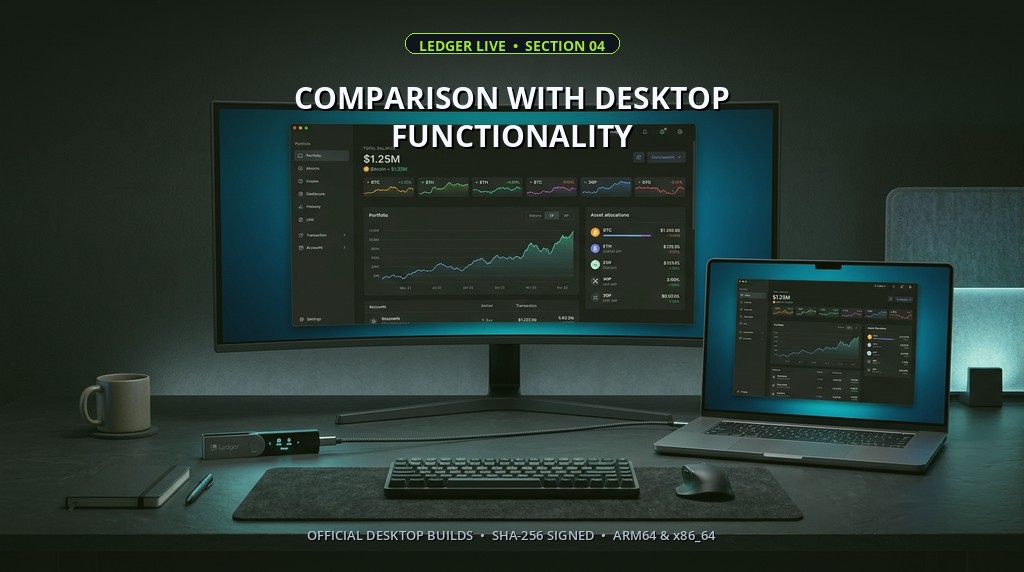
| Feature | Mobile | Desktop |
|---|---|---|
| Transaction signing | Requires hardware link | Direct via USB |
| Portfolio alerts | Push notifications | Email/webhook |
Ledger Live Android
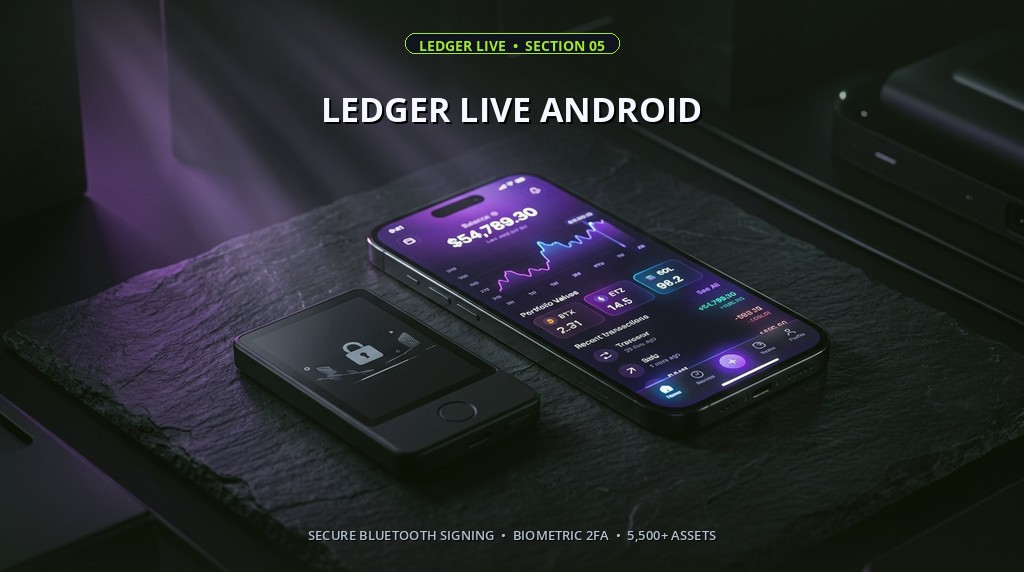
Install the native app only from the official Google Play store–third-party APK files risk exposing your crypto assets to malware. Current version 2.56 requires Android 9 or later, with 100MB storage free for full blockchain data syncing.
The mobile interface mirrors desktop functionality, allowing on-the-go portfolio tracking, Ethereum staking, and hardware wallet management. Real-time price alerts trigger at thresholds you set, while transaction histories export as CSV for tax reporting.
Biometric authentication via fingerprint prevents unauthorized access if your phone is lost. Always verify receive addresses on your hardware device’s screen before confirming transfers–the app’s display alone isn’t trustworthy against address-swapping exploits.
How to install Ledger Live on your Android device
Download the app directly from the official Play Store. Open the store, search for the app by its exact name, and tap the install button. Ensure your phone runs a compatible operating system version.
Once installed, launch the application from your home screen or app drawer. Grant the necessary permissions when prompted, such as access to notifications or storage, to ensure smooth functionality.
Set up your account by following the on-screen instructions. You’ll need to create or import a wallet, which involves securely backing up your recovery phrase.
Connect your hardware wallet via USB or Bluetooth, depending on the model. The app will guide you through the pairing process to sync your device.
Verify the app’s authenticity by checking the developer’s name in the Play Store. Always avoid third-party sources to minimize security risks.
| Step | Action |
|---|---|
| 1 | Search in Play Store |
| 2 | Install the app |
| 3 | Launch and set up |
Once completed, you can manage your crypto assets seamlessly from your handheld device.
Connecting your Ledger hardware wallet to Ledger Live Android
Begin by installing the companion application from the official app store before plugging in your cold storage device.
The USB-C or micro-USB cable must support data transfer, not just charging. Third-party cables often fail during handshake procedures between devices.
After launching the mobile interface, reject any firmware update prompts until verification completes. Counterfeit units frequently push corrupt packages at this stage.
When the PIN screen appears, check the digits against your physical device. Mismatched displays indicate man-in-the-middle hardware intercepting the connection.
Enable blind signing only for defi interactions requiring contract approvals, then immediately disable it afterward to prevent unauthorized transaction alterations.
Test the setup by sending 0.001 ETH to a burner address. Verify blockchain confirmation independently through a block explorer, not just the interface display.
Managing cryptocurrency portfolios in Ledger Live Android
Sync your hardware wallet with the app to automatically track balances and transactions across multiple coins.
Once connected, your portfolio dashboard displays real-time values for Bitcoin, Ethereum, and other supported assets. Use the asset allocation chart to quickly visualize your holdings’ distribution. Customizable views allow sorting by percentage or fiat equivalent.
For detailed insights, tap on any asset to view its transaction history. Each entry includes dates, amounts, and transaction IDs. Enable price alerts to receive notifications when an asset reaches a specific threshold.
To add new assets, navigate to the accounts section and select “Add account.” Choose from over 1,800 supported coins and tokens. Integration with decentralized finance platforms lets you track staking rewards or liquidity pool earnings.
Export your portfolio data as a CSV file for tax reporting or analysis. The export includes timestamps, transaction types, and fiat equivalents based on historical rates.
Optimize your portfolio by using the “Send” and “Receive” features directly within the app. Confirm transactions securely on your hardware wallet. Regularly update the app to access support for newly added coins or features.
Always confirm transactions on your hardware wallet before approving. Avoid using public Wi-Fi when accessing sensitive account information.
Sending and receiving crypto via Ledger Live Android
Always verify the recipient address twice–transactions are irreversible once confirmed on-chain.
The mobile app supports BTC, ETH, and 20+ other assets directly synced with your hardware wallet. Network fees vary by congestion; review estimated costs before confirming.
Tap "Receive" to generate a deposit address. Each coin has a unique string–never reuse an old one after multiple transactions.
QR codes speed up address entry. Scan them in well-lit conditions to avoid misreads that could redirect funds.
ERC-20 tokens require ETH for gas. Keep at least 0.005 ETH ($10-15) available for token movements or approvals.
Cross-chain transfers need intermediary steps. Moving DOT to SOL, for instance, requires converting via an exchange first.
Test small amounts first when interacting with new contracts. Sending 0.0001 BTC (~$4) verifies the pipeline before larger sums.
Securely staking assets through Ledger Live Android
Always verify staking contracts manually before confirming transactions – the app's built-in validator displays contract details in readable format.
Cold storage-compatible staking via mobile requires specific delegation confirmation screens. The interface shows real-time estimated rewards while keeping private keys entirely offline using Bluetooth-secured hardware confirmation. Delegated amounts update every 4-6 epochs depending on blockchain protocols.
For ETH staking, the minimum activation balance appears prominently during the staking flow, preventing failed deposits. Compound interest calculations reflect each protocol's specific mechanics – Tezos pays every cycle, while Polkadot uses era-based distributions. Network fees deduct automatically from unstaked amounts rather than requiring separate gas reserves.
Official support documentation covers mobile-specific staking scenarios: https://support.ledger.com/
Dual-confirmation architecture requires tapping both hardware buttons before broadcasting any staking transaction, even when using biometric authentication on the handset. This prevents malware from initiating unauthorized delegation.
Troubleshooting common Ledger Live Android issues
First, force-close the app from device settings if it freezes during synchronization–this clears cached session data without affecting your assets.
If Bluetooth pairing fails between your hardware wallet and phone, toggle airplane mode for 10 seconds, then re-enable connectivity modules in this exact sequence: mobile data off, Wi-Fi on, Bluetooth last.
Update issues often stem from Play Store cache corruption. Navigate to Settings > Apps > Google Play Store > Storage, then tap "Clear Cache" before retrying.
When the interface displays blank asset balances despite successful sync, disconnect all VPN services–corporate or personal–as they frequently interfere with API calls to price oracle servers.